Project introduction
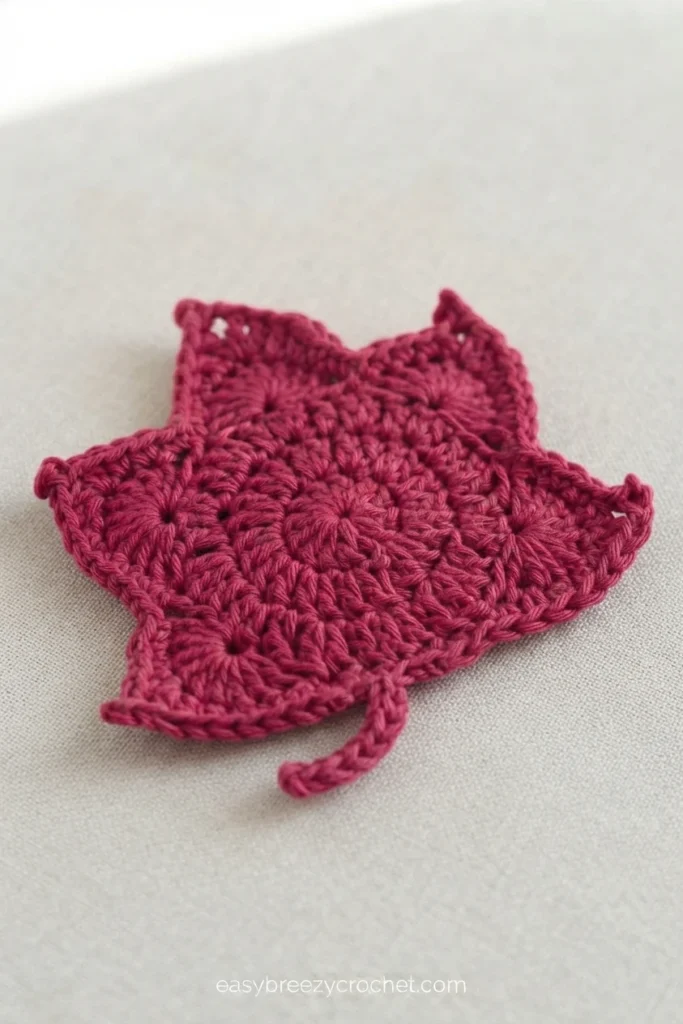
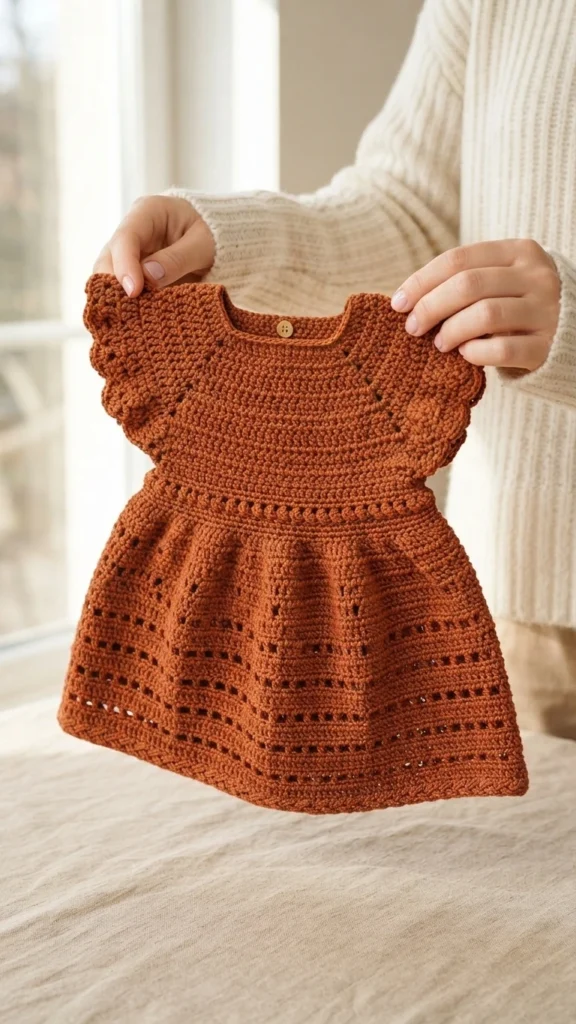
The burnt orange flutter sleeve baby dress, called the Maple Dress by its creator, combines a shaped yoke, filet mesh skirt panels, flutter sleeves, and a braided hem. The Original designer’s pattern and instructions are published by 11crochet. This overview helps you assess the project, and it does not replace the designer’s directions.
Rated intermediate, the dress builds a garment shape through several changes in fabric and silhouette. The upper section uses raglan shaping, followed by an A-line skirt with solid and openwork areas. Sleeve and hem finishes add decorative detail. The notes below cover the pattern’s structure, materials, measurements, and techniques.
Why This Baby Dress Pattern Works
The fitted yoke is worked seamlessly from the neckline down with raglan style increases, so the shoulders need no seaming and the fit stays smooth across the chest and back. The flutter sleeves are worked separately and attached at the armhole openings, which gives control over the ruffle size and shape.
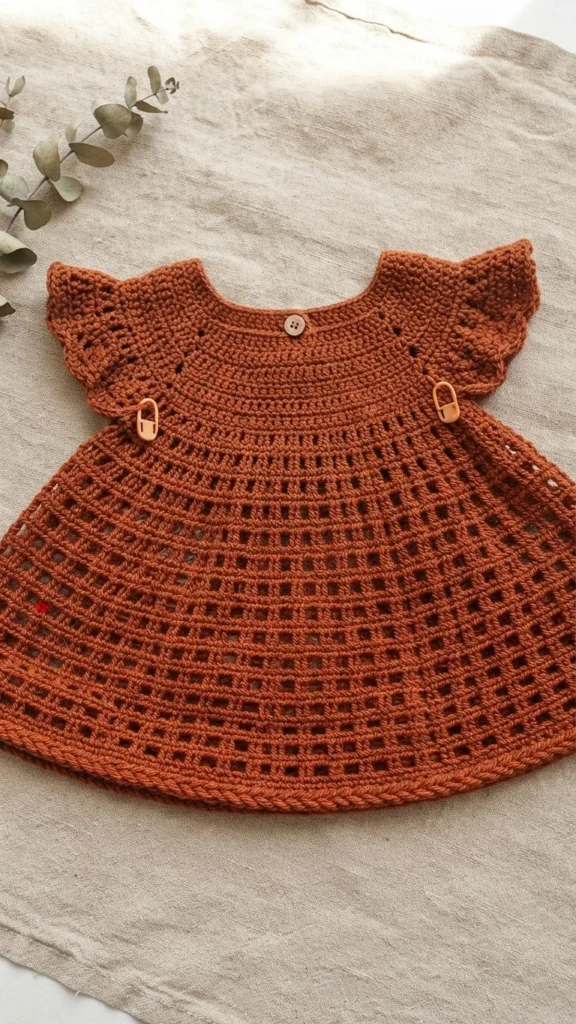
The A-line skirt alternates solid rounds and filet mesh panels, creating visual interest and drape. Cotton suits this section because it hangs with enough weight while staying breathable. At the hem, a three strand braid adds structure and a polished, heirloom quality edge.
Skill Level and Time Estimate
The pattern is rated intermediate. Comfort with working in the round, increasing and decreasing, and following a multi section pattern is expected. Top down yoke construction with raglan shaping, filet mesh patterning, and the three dimensional braided border may be new techniques for some crocheters.
The source estimates 8 to 12 hours for an experienced intermediate crocheter working the 6 to 12 month size. For a first top down garment, it suggests adding 3 to 4 extra hours for learning the construction method. Treat these as planning estimates, since pace and familiarity vary.
Finished Measurements
The pattern includes two sizes, with the primary instructions for 6 to 12 months and 12 to 18 month measurements in parentheses where numbers differ. Compare the finished dimensions with a garment that fits the intended wearer before choosing a size.
- 6 to 12 months: 18 inches (46 cm) chest circumference, 13.5 inches (34 cm) from shoulder to hem, 4.5 inches (11.5 cm) yoke depth, and 9 inches (23 cm) skirt length.
- 12 to 18 months: 20 inches (51 cm) chest circumference, 15 inches (38 cm) from shoulder to hem, 5 inches (12.7 cm) yoke depth, and 10 inches (25 cm) skirt length.
The source presents the larger-size measurements in parentheses where they differ from the smaller size.
Materials Needed for This Crochet Baby Dress
Gather the supplies listed for the project. The color is intended as a single shade rather than a contrast combination.
- DK weight yarn, also called Light Worsted or CYCA 3, in 100% cotton or a cotton blend, in burnt orange or terracotta.
- Approximately 350 yards (320 meters) for size 6 to 12 months, or 420 yards (385 meters) for size 12 to 18 months.
- US E-4 crochet hook, 3.5 mm.
- One wooden shank button, 1/2 inch (12 mm) in diameter.
- Yarn needle, four stitch markers, and scissors.
Yarn Suggestions
The designer names Lion Brand 24/7 Cotton in Terracotta as the top recommendation, citing its consistent twist, stitch definition for the filet mesh sections, and machine washability. Paintbox Yarns Simply DK in Burnt Terracotta is a budget friendly alternative with rich color saturation and a smooth texture. Drops Safran in Rust contains 60% cotton and 40% viscose, and the source notes that the viscose adds subtle sheen and drape while the yarn runs slightly lighter, so swatching and hook adjustment may be needed.
Any DK weight yarn that achieves gauge will work. The source favors cotton or a cotton blend over acrylic for infant garments because cotton breathes better and holds stitch definition. Wash and dry the gauge swatch before measuring, since cotton yarns can grow with washing.
Gauge
Gauge is critical for a fitted garment. The blocked single crochet gauge is 18 stitches by 22 rows per 4 inches (10 cm) in single crochet worked in the round. The blocked double crochet gauge is 14 dc by 8 rows per 4 inches (10 cm) in standard double crochet. One filet mesh repeat, described as chain 1 and double crochet, measures approximately 0.57 inches (1.45 cm) wide.
The swatch guidance is to chain 24, work single crochet back and forth for 24 rows, block the swatch, and measure an interior 4 inch (10 cm) square. If the swatch is too small, go up one hook size; if it is too large, go down one hook size. Measure after blocking.
Abbreviations (US Terms)
The directions use US crochet terminology. This key collects the abbreviations provided in the source, and its notation guidance explains how parentheses, brackets, and asterisks group or repeat instructions.
- ch, sl st: chain, slip stitch.
- sc, hdc, dc, tr: single crochet, half double crochet, double crochet, treble crochet.
- sk, st(s), sp(s), rep: skip, stitch(es), space(s), repeat.
- pm, sm: place marker, slip marker.
- BLO, FLO: back loop only, front loop only.
- RS, WS, rnd: right side, wrong side, round.
- inc, sc2tog, dc2tog: increase, single crochet two together, double crochet two together.
Consult the complete abbreviation key while crocheting if you need the stitch definitions or the precise meaning of a notation mark.
Special Stitches and Techniques
Scallop Edging (Flutter Sleeves)
The flutter sleeve edge is a repeating fan shaped scallop. Each scallop uses 6 stitches total: skip 2 stitches, work 5 dc into the next stitch for the fan shape, skip 2 stitches, then slip stitch into the next stitch. The placement is around the sleeve opening, including the underarm area.
Mesh Stitch (Skirt Body)
The skirt mesh creates open, lacy panels. The repeat is chain 1, then double crochet in the next stitch, chain 1, and skip 1 stitch across, ending with a double crochet in the last stitch. Each repeat is 2 stitches wide. On following rounds, the mesh is either continued or filled in with solid double crochet depending on the instructions.
Braid Border (Hem)
The hem detail uses six yarn lengths, divided into three groups of two strands and braided around the edge. For size 6 to 12 months, the source specifies lengths of approximately 54 inches (137 cm) each. The bundle is attached at the join point with a lark’s head knot, braided with moderate tension, joined into a loop, and tacked to the hem at 1 inch (2.5 cm) intervals. An alternative is to braid three crochet chains, each the length of the hem circumference, and sew them to the edge.
Construction Overview
Section 1: Neckband and Yoke Setup
The neckband is worked flat for two rows first to create the back opening and button loop, then joined into a ring for working in the round. The source gives a neckline circumference of 11 inches (28 cm) for size 6 to 12 months and 12 inches (30.5 cm) for size 12 to 18 months, with a neckband height checkpoint of approximately 0.5 inches (1.3 cm).
Section 2: Raglan Yoke
The yoke is worked in the round around four marked raglan points. Each increase round adds 8 stitches total, with one increase on each side of each marker. The depth checkpoints are approximately 4.5 inches (11.5 cm) for size 6 to 12 months and 5 inches (12.7 cm) for size 12 to 18 months, measured from the neckband.
Section 3: Separate Sleeves from Body
At the armhole stage, sleeve stitches are placed on hold while the front and back are joined to continue the body, with chain bridges forming the underarms. The folded body width checkpoint is approximately 9 inches (23 cm) for size 6 to 12 months or 10 inches (25.5 cm) for size 12 to 18 months.
Section 4: Bodice
The bodice continues in joined double crochet rounds without increases or decreases. The source gives four rounds for size 6 to 12 months and five rounds for size 12 to 18 months. This section leads from the yoke and joined body to the waist transition.
Section 5: Waist Transition Round
A single back loop only single crochet round marks the waist before the skirt widens. The source describes this stitch placement as drawing the fabric inward slightly, creating definition at the waist.
Section 6: Skirt
The skirt alternates solid rounds with mesh rounds and includes increase rounds that shape the A-line profile. The 6 to 12 month version ends after Round 14. The 12 to 18 month version continues through Round 16 and has a stated final stitch count of 184 stitches. Tracking the chosen size throughout the skirt matters because the round sequences differ.
Solid rounds and mesh rounds treat the fabric differently, and increase placement contributes to the skirt’s shape. Keep the size and round sequence consistent with the designer’s directions instead of substituting a generic mesh repeat.
Section 7: Hem Finishing Round
The hem finishing round forms the base for the braid border. The source lists 168 single crochets for size 6 to 12 months and 184 for size 12 to 18 months. The braid is added after this edge is complete.
Section 8: Flutter Sleeves
The held sleeve stitches are removed from the waste yarn, and the scalloped edging is worked around each armhole opening, including the underarm chain stitches. The source repeats the treatment for the second sleeve, and its placement details shape the finished ruffled outline.
Finishing
Finishing includes sewing the wooden button to the left back neckline, aligned with the button loop on the right, weaving in the yarn tails securely, and wet blocking the dress. The source advises soaking the garment in lukewarm water for 15 minutes, gently squeezing out excess water without wringing, shaping it flat to the measurements, and allowing it to dry completely.
Care Construction Overview
The source notes that this cotton baby dress is machine washable. Wash on a gentle cycle with cold water, then lay flat to dry or tumble dry on low heat. Cotton may shrink slightly with the first wash, which is why blocking to measurements before gifting or using is important. Check the yarn label as well, especially when using a blend or substitute.
Tips for Success with This Crochet Tutorial
- Count stitches during the yoke section, where every round increases. Use stitch markers at each raglan point and count after every round.
- Try the fit on as you go. If a baby or similarly sized doll is available, slip the dress over their head after completing the yoke to check the fit before continuing.
- Block the gauge swatch before measuring, since cotton yarn behaves differently after washing and the swatch shows how the finished dress will measure after its first wash.
- Take photos of your progress to help troubleshoot if something goes wrong.
Thank You for Making the Maple Dress
The Maple Dress brings together a top-down yoke, a flared skirt with solid and mesh areas, flutter sleeves, and a braided hem. Its two sizes, cotton-focused materials guidance, and decorative finishing make it a distinctive intermediate garment project. Use this overview to prepare, and rely on the designer’s complete directions for the size-specific construction and stitch sequence.