Project introduction
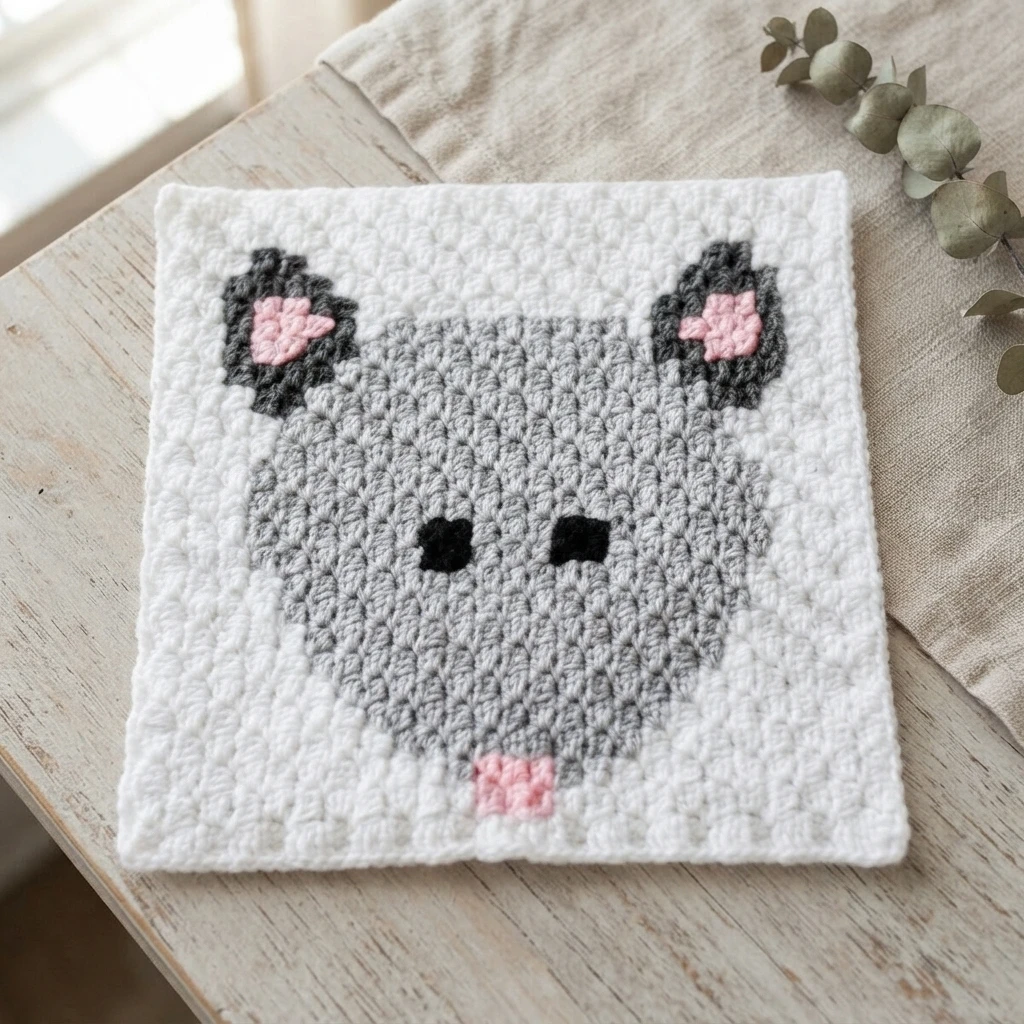
This article is an overview of a corner-to-corner crochet opossum panel, not a complete set of directions. The square features an opossum face and can be used in a blanket, pillow, wall hanging, or another handmade project. It may also suit a baby, nursery, or animal-themed make. Melissa of Lovable Loops designed the panel, which is one of 12 animal designs in her woodland baby blanket pattern. For the full graph or written directions, visit Melissa’s original pattern and instructions.
C2C crochet opossum pattern details
Check the listed skill level, supplies, finished size, gauge, and abbreviations before choosing your materials. These details describe the opossum panel and help you prepare to follow its colorwork chart or written format.
Skill level
The designer rates this project for advanced beginners. It uses the corner-to-corner (C2C) method and includes color changes. Some familiarity with C2C blocks can be useful, especially when following a color chart, but refer to the designer’s directions for the actual sequence.
Materials needed
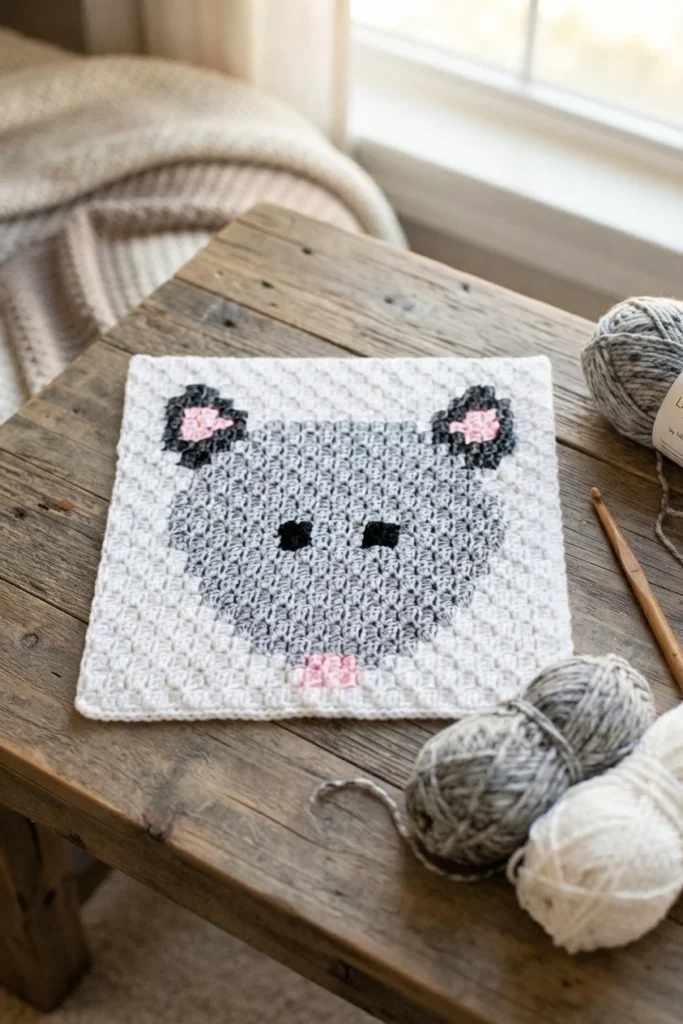
The supply list names a hook, worsted weight yarn in five colors, and basic finishing tools. The brand and shades below are those used for Melissa’s sample. The source does not give yarn quantities, so check the linked instructions for any further supply information.
- One G-6 crochet hook, 4 mm.
- Worsted weight yarn. The sample uses Red Heart Super Saver in white, black, light gray, charcoal, and baby pink.
- A yarn needle for weaving in the yarn ends.
- Scissors for fastening off.
- Stitch markers, optional, to help keep track of stitches.
The source does not list substitute yarns or alternate hook sizes. If you choose different materials, keep in mind that the stated gauge and finished measurement are for the project as described by its designer.
Finished size
The completed panel is listed as 14 by 14 inches (36 by 36 cm). Use that measurement when considering how the square may fit with other pieces. The source gives this size for the opossum panel.
Gauge
The listed gauge is 8 blocks, with each block made of chain 3 plus 3 double crochet, measuring 4 inches (10 cm). This is the designer’s gauge reference for the panel. The source does not provide a separate swatching method.
Crochet terms
The directions use US crochet terminology. These abbreviations are used:
- dc: double crochet
- sc: single crochet
- ch / chs: chain / chains
- st / sts: stitch / stitches
- sl st: slip stitch
The C2C blocks are described with chain and double crochet stitches, while the border notes use single crochet. Keeping the abbreviations nearby can make the chart notes and written directions easier to follow.
Pattern notes
The square is worked in diagonal C2C rows, starting at the bottom-right corner and ending at the top-left corner. Each block consists of chain 3 and 3 double crochet. The notes call for chain 6 to start a new row and chain 3 to start a new block. These are orientation details rather than a substitute for the complete directions.
The design can be followed from a graph or a written version. The written directions identify the number of blocks to make in each color and their order. Direction arrows indicate which side is being worked: the down-left arrow marks the right side, and the up-right arrow marks the wrong side. The terminology is US style.
C2C crochet opossum Construction Overview
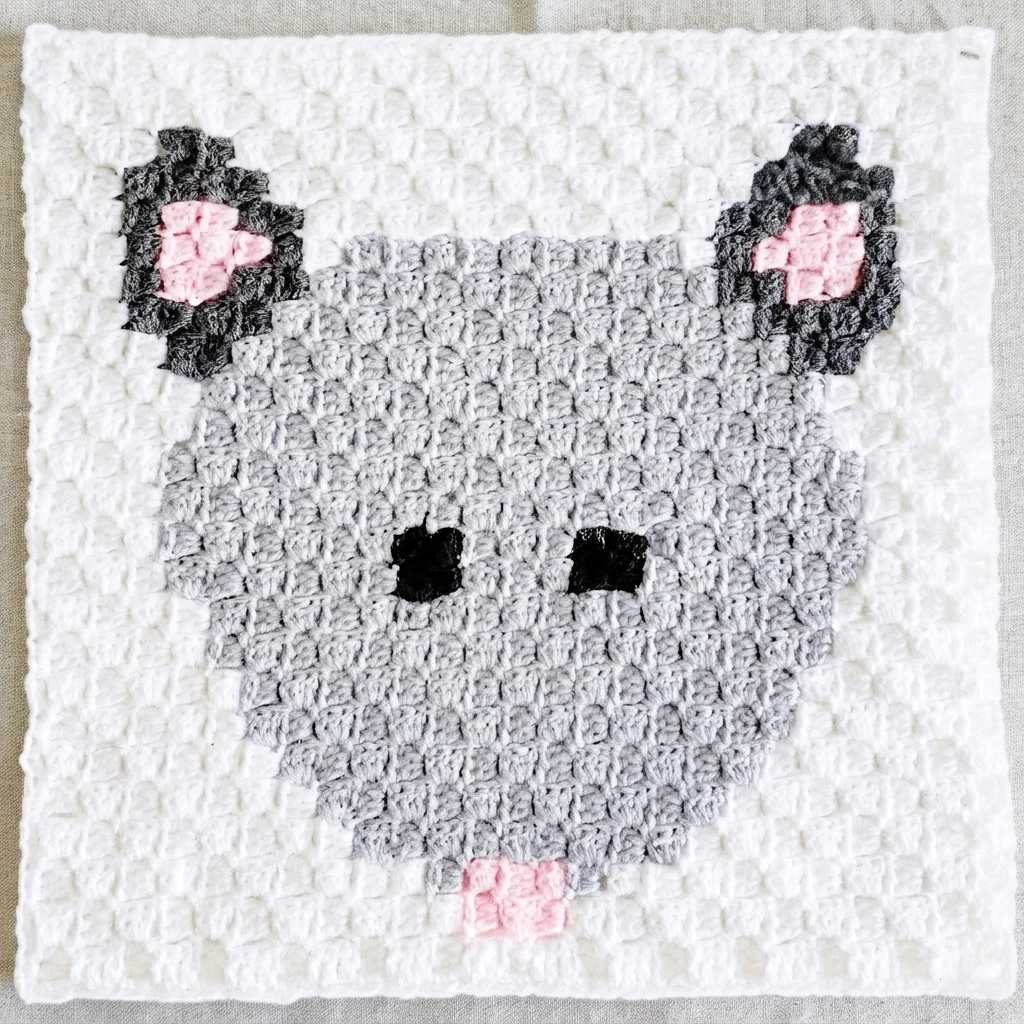
The square is made by following either the graph or the written directions. The graph shows the color placement visually, while the written version lists the color blocks in sequence. Choose the format that works best for you, and use Melissa’s linked instructions for the complete color sequence.
Graph
A graph is included with the designer’s pattern materials. It offers a visual reference for the opossum design and its color placement. Consult the linked pattern page for the graph and related information.
Written Construction Overview
The written version covers 49 rows and gives the color and block count for each. Its opening rows use white. Gray and pink enter as the design develops, with black and dark gray also appearing in the central colorwork. Later rows include white and gray arrangements, then a smaller area of dark gray and pink, before the final rows return to white.
This is a high-level description, not a replacement for the row-by-row color order. Because the placement of each shade forms the image, keep the designer’s chart or written directions available while crocheting. The direction markers distinguish right-side and wrong-side rows, and the supplied instructions provide the specific block sequence.
Adding a border
After the final C2C block, the instructions continue around the edge of the square. The border notes begin with chain 1, then call for 2 single crochet along the side of each block. At each corner, work single crochet, chain 2, and single crochet. Follow the original directions for where to place these stitches as you travel around the panel.
Finishing
Weave in the yarn tails when the panel is complete. Blocking is optional in the designer’s notes. The source does not specify a blocking method, so treat blocking as an optional finishing choice.
C2C video tutorial
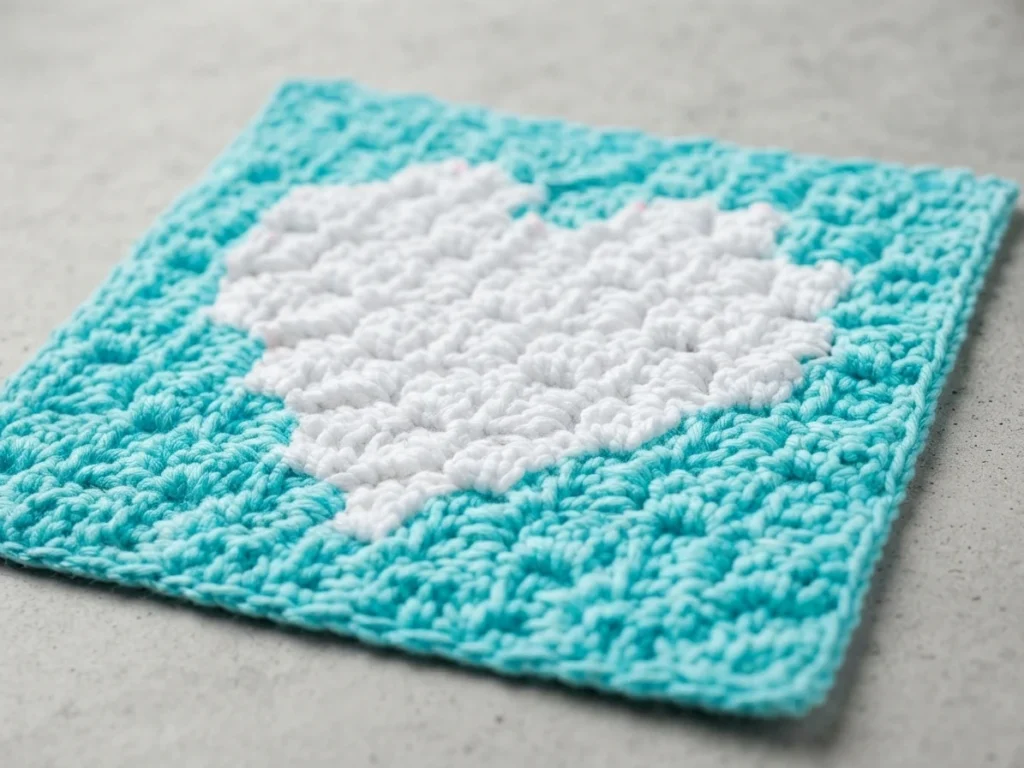
For a visual introduction to the C2C technique, Melissa also shares a step-by-step C2C tutorial using a mini heart square. It focuses on the technique rather than the opossum color sequence, so refer to the opossum directions for the panel’s specific colorwork.
Let’s connect!
Use the listed size and supplies to decide whether this panel suits your project, then follow Melissa’s linked instructions when you are ready to make it. If you would like to explore another pattern overview, see Crochet Gary the Snail Opossum: Pattern Overview.