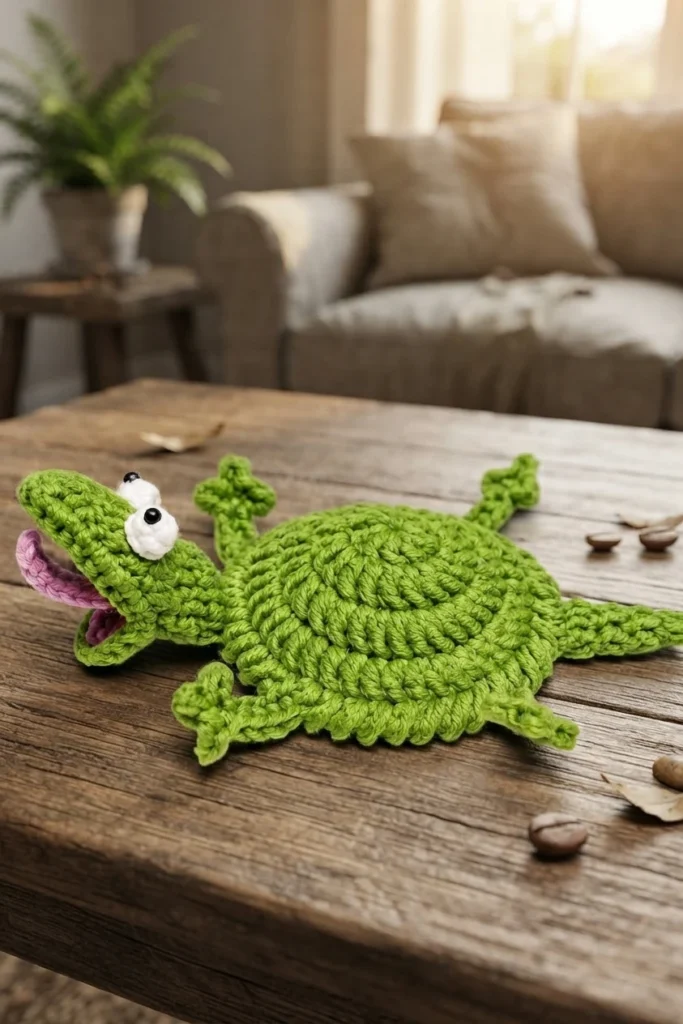
This is a pattern overview, not a full crochet tutorial. It introduces the construction, materials, and finishing choices for Craftbits’ playful lizard coaster, while leaving the complete stitch-by-stitch directions with the original source. The design pairs a round coaster base with a head, open mouth, tongue, eyes, four limbs, and a curved tail.
What you need
Gather the source-listed supplies below before beginning. The pattern calls for a hook suited to your yarn, but it does not specify a hook size or a millimeter equivalent. Choose a hook based on your yarn and your own fabric tension rather than assuming a particular size.
- Green yarn for the body, head, legs, and tail
- Red yarn for the inside of the mouth, pink yarn for the tongue, and white yarn for the eyes
- Small black safety eyes or black embroidery thread
- A crochet hook suited to the yarn; no US size or metric equivalent is given in the source
- A yarn needle, scissors, and a stitch marker
- Poly-fil, optional, for lightly shaping the head
- A hot glue gun or a sewing needle for assembly
Cotton is suggested for a firmer coaster fabric than very fluffy yarn. If the yarn is thin, the source suggests holding two strands together for the body to add structure. These are material choices, not specified yarn weights or quantities.
Construction Overview
The project is assembled from several distinct crocheted shapes: a flat circular body, an open-ring head shaped into jaws, a narrow tail, and smaller details for the mouth, tongue, eyes, and limbs. The source presents the components separately, then attaches them to create the lizard silhouette. For the complete pattern and instructions, see the Original designer’s pattern and instructions.
This overview is meant to help you understand the project before you begin, not replace the linked directions. The source lists stitch totals for several components, but no unresolved contradiction in those stated totals is identified in the supplied material. If your work does not match a listed total, check the original instructions closely rather than guessing at a correction.
Abbreviations
The pattern uses US crochet terminology. Its shorthand includes ch for chain, sl st for slip stitch, sc for single crochet, hdc for half double crochet, and dc for double crochet. An increase, or inc, means working two stitches into one stitch; dec means crocheting stitches together. The more specific hdc2tog and dc2tog mean half double crochet two together and double crochet two together.
Other pattern shorthand is st or sts for stitch or stitches, rnd for round, and rep for repeat. If an abbreviation is unfamiliar, refer to this glossary and the linked pattern before working that section.
Pattern Notes
The body and head are worked in joined rounds, while the tail and eye pieces use continuous spirals without joining at each round’s end. A stitch marker helps track the start of spiral work. The jaws are made in turned rows, and the upper jaw does not use a turning chain. The source also distinguishes beginning chains that count as stitches from those that do not, so keep those notes beside you as you work.
Raised pieces can affect how the coaster sits. The source advises keeping the underside as flat as possible when attaching them, an especially useful point to consider as you position each detail.
Main Body
The green body begins as a magic ring and grows into a flat circle through joined rounds. The source describes increases across the early rounds, followed by a reverse single crochet edging. After completing the edge, the body is fastened off and the yarn ends are woven in. This provides the flat base to which the other lizard features will be attached.
Tail
The tail is crocheted in green from a magic ring in a continuous spiral. Its shape widens and narrows through increases and decreases, then it is fastened off with a long sewing end. The source says to leave it unstuffed, flatten it, and curve it gently. During assembly, the closed end is attached to the body while the ring end remains the tail tip.
Head
The head starts with a green chain joined into an untwisted ring, then is worked around that foundation in joined rounds. Its shaping combines double crochet, half double crochet, and single crochet. The source notes that the piece will still look like an open ring or tube after these rounds; the jaw sections are added afterward, so this unfinished appearance is expected.
Upper Jaw
The upper jaw is formed in turned rows across part of the head. Its first row widens the section, while later rows decrease toward a narrower edge. No turning chain is used for these rows, and the first increase or decrease begins immediately after turning. Finish this piece as directed before moving to the lower jaw.
Lower Jaw
The lower jaw is worked separately across the front of the head, beginning below the upper jaw. The source shapes it in two turned rows, using half double crochet and decreases to narrow the edge. Its second row uses decreases at both ends with two half double crochets between them. Fasten off and weave in the end as the linked pattern directs.
Inside Mouthpiece
The red mouthpiece is a small oval made around both sides of a foundation chain. It sits between the upper and lower jaws, creating the colored interior of the open mouth. The source leaves a long yarn tail for sewing the oval securely in place. Take care with its placement so the red section fills the opening without obscuring the jaw shape.
Tongue
A pink tongue is attached at the center front of the red mouthpiece. The source describes a simple straight shape and also offers an optional forked tip. The straight version is easier to make and keeps the mouth area less bulky, while the forked variation adds a little extra character.
Eyes
Make two small white eye pieces in continuous spiral rounds. Their stitch count stays the same from one round to the next, which forms a small raised bump. Add either a black safety eye through the center before attaching each piece, or embroider a black pupil after the white pieces are sewn to the head. Secure any chosen eye detail carefully.
Arms and Legs
Four green limbs give the lizard its small toes. Each one begins from a chain foundation, with two short toe extensions formed before the remaining part of the limb is completed. Leave a long sewing end on each finished piece. The original directions explain how the toe sections connect to the foundation, so use them for the exact placement and stitch sequence.
Assembly
Lay the body flat with its right side facing up. Attach the curved tail at the back or side and sew the head to the opposite edge, with the mouth facing outward. Position the red mouthpiece and tongue, then add the eye bumps and place two limbs on each side. Weave in loose ends and check that the features are secure while keeping the underside as flat as possible.
If the finished body needs shaping, the source suggests light damp-blocking: pin it into shape and let it dry completely. For acrylic yarn, it cautions that steam should be used carefully and that the iron must not touch the yarn.
Optional Felt Backing
A felt backing is an optional way to add stability. The source describes cutting a felt circle slightly smaller than the body and hand-sewing it to the underside. Fabric glue is another possibility only when it suits the yarn and the coaster will be spot-cleaned. If washing may be needed, the source favors a sewn backing.
Care and Use
Follow the care guidance for your chosen yarn. Cotton versions can usually be gently hand-washed, reshaped, and dried flat. Because the eyes, mouth, and tongue are raised, place a mug or drinking glass over the flat center of the body. This coaster is for drinks, not extremely hot cookware, and should not be used as a potholder or trivet.
Project Ideas
The source suggests changing the color palette to alter the character: choose varied greens, brighter shades for a cartoon look, or earthy browns and greens for a gecko-inspired appearance. A finished coaster can also be paired with a mug and a tea bag or coffee sachet, or included in a teacher, reptile-lover, or garden-themed gift selection.